

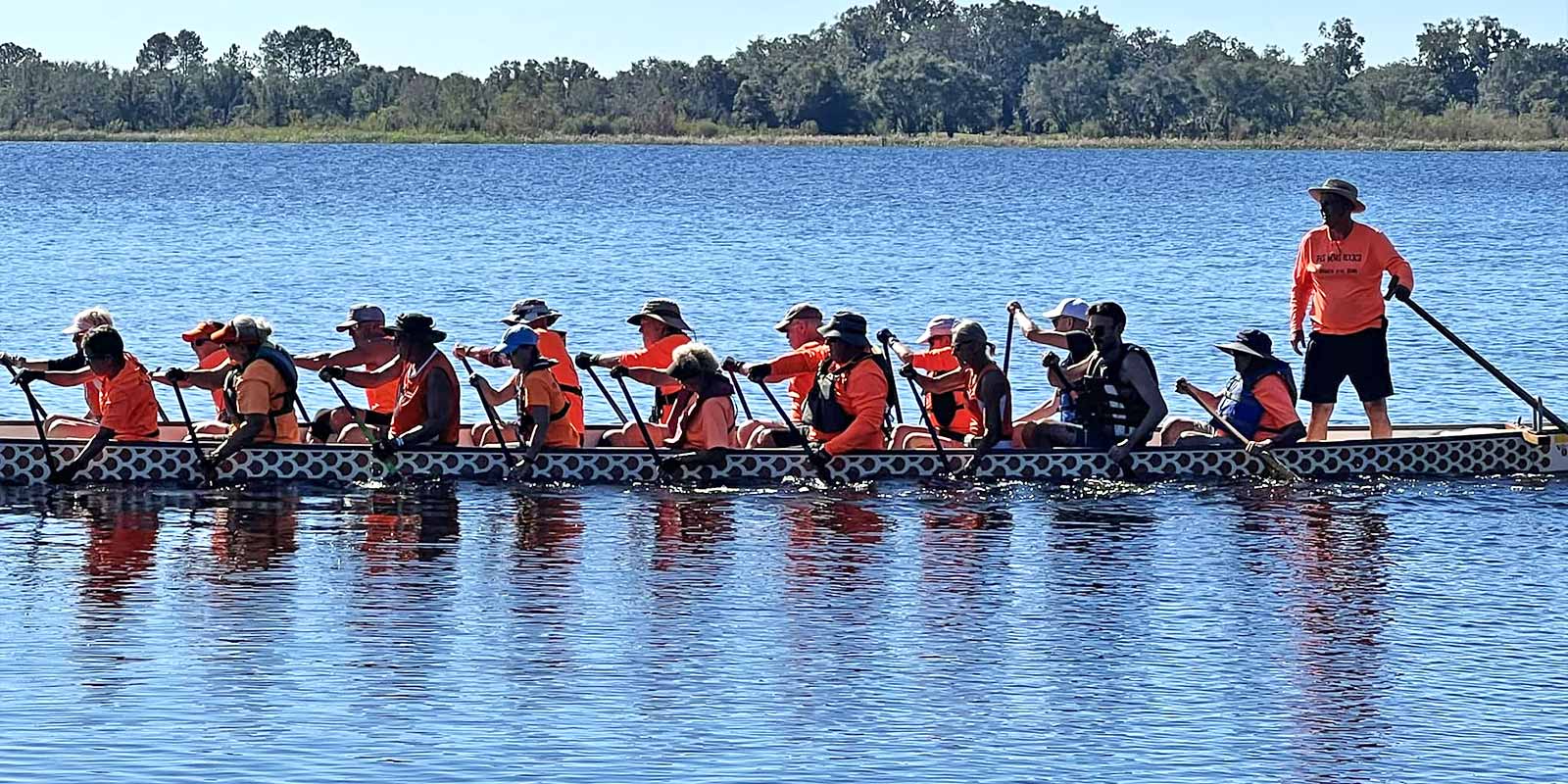
You’re welcome to paddle up to 3 times before deciding if dragon boating is for you.
On your 4th visit, please bring a check made out to “TBR” for $45 ($20 annual Grand Masters dues + $25 monthly TBR dues). If you join on or after July 1, Grand Masters dues is reduced to $10, so the total due is $35 ($10 + $25).
Equipment will be provided for your first 4 paddles. After that, you’ll need to purchase your own gear.
For safety, you must wear a visible waterproof ID with emergency contact information every time you’re on the boat. Options are available at www.roadid.com.
To paddle you must have:
Optional (but strongly advised): sunglasses, cushion to sit on, gloves
A PDF, paddle and seat will be provided to you when you first come to paddle. After you have paddled 3 times and then decided to join TBR, you will need to purchase your own equipment.
You will be able to paddle 3 times at no charge. TBR dues are $25/monthly whether you paddle 1 or 30 times in that month.
There will be no charge if you did not paddle for the entire month.
$20/Grand Masters
(Annual fee due by January 1, 2026)
$45/First Month
($25 monthly Dragon Boat dues + $20 annual Grand Masters dues)
$25/Monthly
(After Grand Masters dues are paid)
THE FOLLOWING DISCOUNT IS AVAILABLE:
$145/6 month (One month discount)
($20 for annual Grand Masters dues + 5 months at $25 = $145)
If you do not have an I.D., a temporary one will be given to you at the dock. You will need to come to the dock with the name and telephone number of an emergency contact that you can write on this temporary I.D. THIS EMERGENCY CONTACT NEEDS TO BE SOMEONE WHO WILL NOT BE ON THE BOAT WITH YOU.
A PFD, paddle and seat will be provided to you when you come to paddle. After you have paddled 3 times and then decide to join TBR, you will need to purchase your own equipment.
**This is a requirement by The Villages Recreation Department for all Dragon Boat paddlers. They can be purchased at www.roadid.com
We do not paddles under the following conditions:
Advanced Boat(s)
For the experienced paddlers who want an intense workout that focuses on race training, endurance and drills. Paddlers should already know and be able to execute ALL of the dragon boat commands and be proficient in the correct paddle stroke. This boat will also prepare you for any future races the team decides to participate in.
Beginner / Intermediate Boat(s)
This will be a combined boat of both beginner & intermediate paddlers that will consist of paddlers who have learned the basic commands and know the stroke and those that are learning the basic commands and strokes for the first time.
SAFETY PROCEDURES
Grand Masters Dragon Boat Club
The Villages, Florida
Safety is our #1 priority for any paddler to enjoy the fun and physicality of dragon
boating. Each paddler is responsible for their own safety at all times while engaging in
activities related to practicing and racing in dragon boats. The following procedures
will be followed by all team members as part of any GMDBC team.
SAFETY PLAN
• The steer person is the person in charge of the boat, they are the safety officer. They
are responsible for the boat at all times. Any command of the steer person
supersede any other commands given on the boat. For example, the coach has the
team in the middle of a 300 meter race and the steer person calls, “check and hold
the boat”. The “check and hold the boat” command must be followed.
PRIOR TO BOARDING
1. Wear appropriate clothing for participation in a water sport (comfortable light
clothing, water shoes)
2. Have a bottle of water with you. Consider an electrolyte replenishing fluid during
the summer months, such as Gatorade, or Propel.
3. Apply sunscreen and wear a hat.
4. Stretching and moderate exercise is advisable before paddling.
5. Basic dragon boat commands will be reviewed by a designated team member.
6. Safety and emergency procedures will be reviewed by a designated team member.
7. Notify the team captain if a new paddler is a non swimmer. The steer person will be
notified.
8. All paddlers must have a lifejacket or personal floatation device (PFD) and
emergency identification on their person.
LIFE JACKETS
All paddlers must wear an approved lifejacket or PFD at all times while on the boat.
Belt PFDs should be worn facing forward.
LOADING/UNLOADING PROCEDURES
1. The team captain should know the paddlers approximate weight and balance the
boat accordingly.
2. The boat should be loaded row by row as directed by the team captain or steer
person. All paddles and water bottles should be handed to your seat partner first
before boarding. Once in the boat your partner will hand them to you.3. Step into the center of the boat and then take the assigned seat with hips to the
gunwale.
4. DO NOT step on the seats or gunwale while loading or unloading the boat.
5. Always follow the steer person’s commands when loading and unloading the boat.
6. Once loaded, the steer person should remind the paddlers about the buddy system
and ask them to identify their seat partner or who they should be looking out for in
the event of an emergency.
7. Before leaving the dock, each person should count off to ensure an accurate count.
8. The boat will be unloaded in a similar manner with the steer person calling the rows
to unload.
9. Do not throw paddles, seats or water bottles on the dock while unloading, hand
those items to your seat partner who will then hand them off to you when they
unload.
PADDLING COMMANDS
1. In order to control the boat and avoid possible collisions, all paddlers must know
the basic paddling commands.
1. Check the boat – (drag paddle in the water to slow the boat)
2. Hold the boat – (paddle in the water perpendicular to the side of the boat
3. Let it run – (stop paddling and lay your paddle across your lap)
4. Backpaddle – (paddle from hip to knee)
HYDRATION
The possibility of dehydration is a concern especially during rigorous training, races
and during the summer months. Maintain proper hydration by drinking water or a
replenishing electrolyte fluid before getting into the boat and during the times when
directed during rest periods at practice.
EXERTION LEVEL
Paddling is a high intensity sport and can be exhausting. If you need to rest at any
time, do so. Stop paddling and center your paddle (paddle handle on the floor of the
boat between your feet with the paddle face towards the sides of the boat). Resume
paddling when you feel able. If you feel unwell, notify your seat partner or steer person
so you can be returned to the dock.
NOISE LEVEL
1. Paddlers should restrict talking on the boat. Attention must always be given to the
coach/drummer and steer person. The coach/drummer and steer person must be
able to communicate effectively from the bow to the stern of the boat. The
command, “Heads in the boat” means that everyone must stop talking.
2. There should not be talking while the steer person has control while leaving or
returning to the dock.3. When on the water, emergency help can be a long way off. If someone should have
a medical emergency it is imperative that everyone remain silent as the steer
person gives direction.
4. An air horn is available on all boats, three long blasts will notify the dock that there
is a situation on the boat.
BOAT CAPSIZING
1. A buddy system is used in the event of a medical emergency or boat capsizing.
Your buddy is the person sitting beside you in your row. The paddlers in the first
row are also buddies with the coach/drummer and the paddlers in the last row are
buddies with the steer person.
2. Unless instructed otherwise, paddlers should stay with the boat, hold onto it, find
their partner, do not try to swim to shore and wait for help to arrive. All equipment
will float and can be retrieved later.
3. You must follow the directions of the steer person and rescue personnel. Once a
rescue boat arrives they are in charge.
4. If you find yourself under the boat, there is an air pocket so you can catch your
breath and get your bearings. Cover your head with your hands in the event that
your head may hit the bottom of the boat. DO NOT INFLATE your PFD while under
the boat. Feel your way to the side of the boat and then surface to the outside,
inflate your PFD at this time.
5. Locate your buddy if not already found.
6. If other paddlers are injured or having trouble reaching the boat, provide assistance
and make others or rescue personnel aware of the situation.
7. The steerperson will make a head count.
8. If the boat capsizes, it may not right itself. The steer person will determine if
anyone is trapped under the boat and will act accordingly. A strong swimmer may
be asked to swim under the boat from one end to the other looking for paddlers.
9. If the dragon boat is upside down after capsizing, the steer person may ask the
team to help roll the boat to its upright position. Before that, all paddlers must be
accounted for.
10. Shouting and making noise will cause confusion and panic. Every paddler must be
ready to follow instructions.
11. Keep others calm, do not panic, your PFD and life jacket will keep you afloat.
WEATHER
BOAT STABILITY
To maintain boat stability, make no sudden movements while on the boat. Any
movement on the boat should be fore and aft not side to side. Stay seated in the boat
at all times. In the event of waves caused by passing boat wakes or large waves
continue paddling as usual. The boat will wallow less if it is being propelled forward. Do
not panic and stop paddling. Do not lean into the boat.
SWAMPING
If the boat should swamp (taking in water due to waves or wakes) it will not sink. Do not
abandon the boat, keep paddling, use the bailers or your cupped hands to get as much
water out as possible.
ILLNESS ON THE BOAT
If you feel ill while paddling, stop immediately. Tell your seat partner who will notify the
steer person, or use the sign of distress by holding the paddle up with the face of the
paddle visible to the steer person.
The Steersperson must have a cell phone available while on the boat in the event of a
medical emergency. 911 will be called as soon as possible.
911 Lake Miona – Sumter County Medical Emergency –
City of Oxford – 10501 County Road 115, Lake Miona Park Boat Ramp.
911-Lake Sumter – Sumter County Medical Emergency –
Waterfront Inn (352-753-7535), 1105 Lakeshore Drive. -Lake Sumter Landing Boat
Dock. The emergency addresses are located on the fore and aft of all boats.
Team members not on the boat are asked to keep the boat under observation to be
alert for a possible emergency. If 3 long air horn blasts are heard, the boat is returning
with an urgent need.
Should first responders be required, the members on shore should assist in directing
EMS to the location of the boat. At Lake Miona, fisherman on the dock or in other
boats are asked to be on the alert for an audible signal of an emergency to assist if
they are able.
There are Automatic External Defibrillators (AED) available at each dock. If a paddler is
NOT BREATHING, leave the lake at the nearest safe shoreline, remove the person from
the boat and begin CPR immediately. CPR cannot be attempted on the boat. Use the
app, “Where Am I”. To give emergency services an address closest to where you are
located.
These procedures must be reviewed with all GMDBC team members and least twice
yearly.
New members must review these procedures before boarding the boat for the first
time.
Adapted from suggestions of the GMDBC members and the Philadelphia Dragon Boat
Safety Plans
Revised: 6/2/26
Safety Procedures
L. Braun
READY:
Lay your paddle over the gunnel, leaning forward over your thighs.
That means that you have heard the command and are prepared to go.
PADDLES UP:
Hold your paddle blade above the surface of the water, fully rotated and ready to go.
GO:
Start paddling forward in sync, following your lead paddler.
STAY IN SYNC:
Watch your lead and put your paddle into the water at the same time using the same stroke so that everyone paddling is in sync..
LET IT RUN:
Paddle across lap with paddle blade over the gunnels. Used when you are not paddling and sitting in the boat waiting for instruction.
CHECK THE BOAT:
Drag your paddle in the water to slow the boat down.
HOLD THE BOAT:
Dig your paddle straight down into the water parallel to the side of the boat and fully submerge your blade bringing the boat to a quick stop.
RUDDER THE BOAT:
Paddles deep and parallel in the water to the boat.
CENTER YOUR PADDLE:
Hold your paddle straight up with the blade facing outward, elbows in, lean forward.
FLARE THE BOAT:
This is used to stabilize the boat. Hold blade out to the side. Keep your paddles out and flat on the surface of the water to keep the boat steady. Blade is almost parallel to water and resting on the surface of the water.
PREPARE TO BACK PADDLE:
Blade in the water at your hip.
BACK PADDLE:
Paddle in at hip, entire blade in water, push water forward and repeat.
MY BOAT:
A command that will come from the steersperson when he needs to quickly take control of the boat.
HEADS IN THE BOAT:
Stop talking immediately and pay close attention to what is being said.
UP:
Increase strokes per minute.
PADDLE SALUTE:
You and your paddling partner will take your paddles out of the water and tap the tips together and then return your paddle into the water for the next 3 strokes and repeat.
PADDLES OVER HEAD:
Used to balance the boat. Hip against the gunnel, hold paddle over your head with both hands while leaning out.
DRAW THE BOAT:
Lean out with paddle extended and pull water towards the boat.
LEAN OUT:
Hip should always be tight against the gunnel and your body should be leaning out over the side of the boat.
RACE COMMANDS
STARTER CALLS:
“ALL BOATS HOLD – WE HAVE ALIGNMENT – ATTENTION PLEASE”
SIT READY – HOLD YOUR PADDLE SIDEWAYS ON THE GUNNEL WHILE LEANING AS FAR AS FAR AS YOU CAN.
AS SOON AS THE ANNOUNCER BEGINS TO CALL OUT THE ABOVE,
READY, READY – PUT PADDLE DEEP IN WATER IN RACE POSITION
THE HORN BLOWS… THE RACE BEGINS…
UP:
Pick up the pace each time this is called.
BIG:
Reach out and paddles deep in the water pulling back hard.
BIGGER:
Reach out farther with paddles deep in the water pulling back harder.
BIGGEST:
Reach out as far as possible with paddles deep in the water pulling back as hard as you can, not necessarily fast, just deep and hard.
SETTLE IN:
Keep that steady pace of long and hard strokes.
FINISH NOW:
Give it all you got!
